Quartz vs Porcelain Worktops: Which Is Best for Your Kitchen?
Choosing the right kitchen worktop is one of the most critical decisions in any home renovation. Engineered quartz and sintered porcelain represent the two most advanced, durable surfaces available on the British market today.
While both materials deliver exceptional stain resistance and eliminate the regular sealing required by porous natural granites or marbles, they differ significantly in their material composition, heat tolerance, UV resistance, fabrication requirements, and everyday tactile feel.
To help you select the ideal stone surface for your culinary lifestyle, aesthetic preferences, and budget, this comprehensive guide compares engineered quartz and sintered porcelain across every practical metric.
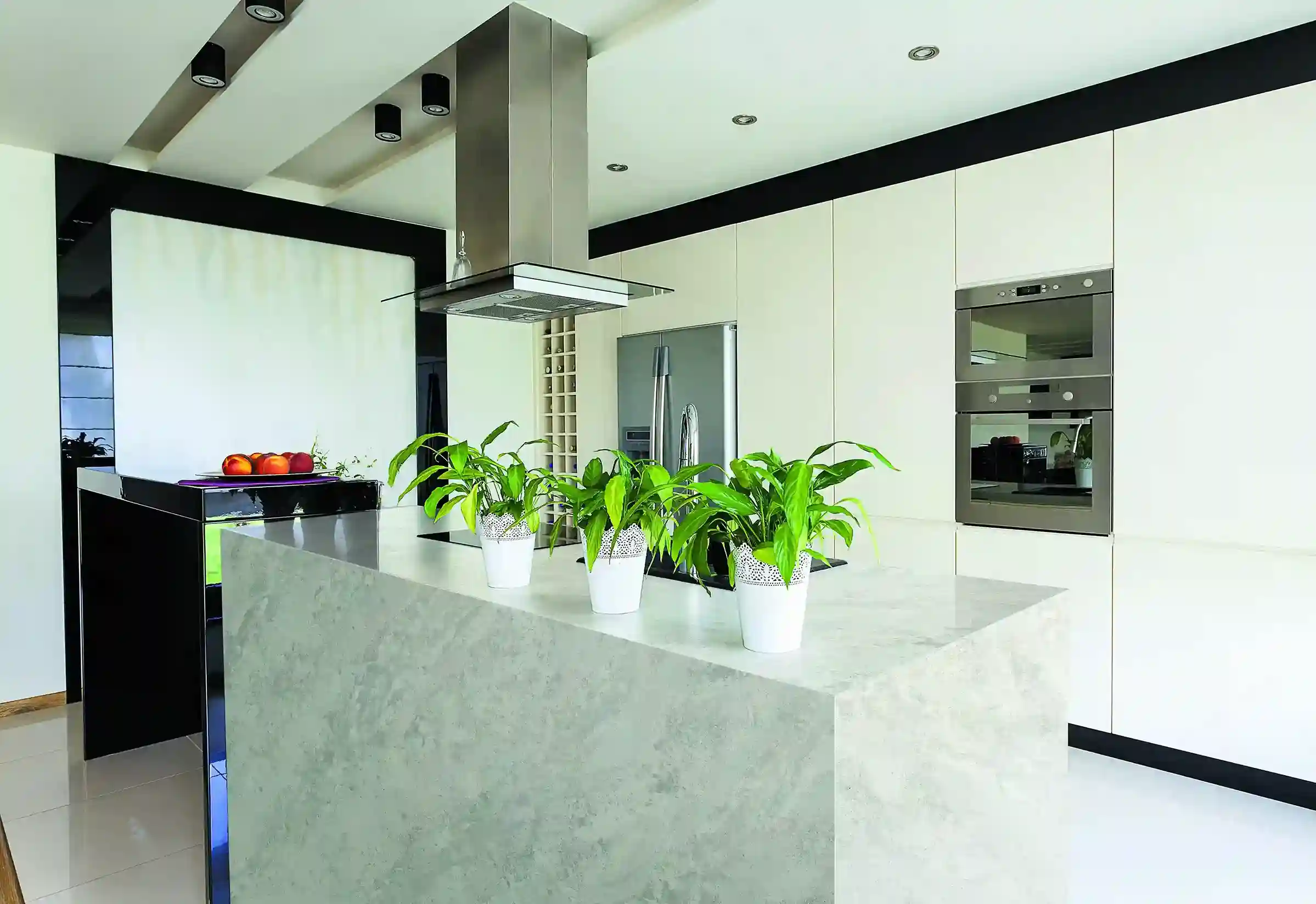
At a Glance: Which Surface Suits You?
Every household has distinct cooking routines and design priorities. Here is how quartz and porcelain align with different kitchen needs.
When to Choose Quartz
- ✓ Busy family kitchens: Slight resin elasticity provides greater impact resilience against accidental knocks with heavy pots.
- ✓ Classic solid presence: Available in 20mm and 30mm solid slabs without requiring built-up sub-frames.
- ✓ Diverse edge profiles: Wide variety of profiles from bullnose to ogee and shark nose.
- ✓ Predictable fabrication: Highly established cutting process with accessible price tiers.
When to Choose Porcelain
- ✓ Outdoor kitchens & BBQs: 100% UV-stable mineral structure will not yellow, warp, or degrade in sunlight.
- ✓ High heat exposure: Vitrified at over 1,200°C, offering superior thermal endurance compared to resin-bound stone.
- ✓ Sleek modern aesthetics: Ultra-slim 12mm and 20mm profiles perfect for contemporary handleless designs.
- ✓ Extreme scratch resistance: Near diamond hardness makes accidental surface scratching nearly impossible.
What Both Materials Offer
- ✓ Zero sealing required: Unlike granite or marble, neither surface requires annual chemical sealants.
- ✓ Non-porous hygiene: Both naturally resist liquid absorption, food bacteria, and mould development.
- ✓ Exceptional stain resistance: Spills of red wine, coffee, turmeric, and cooking oil wipe clean easily.
- ✓ Premium aesthetics: Both deliver faithful reproductions of Calacatta marble, concrete, and fine stone textures.
Direct Comparison: Quartz vs Porcelain
Review key technical and commercial attributes side-by-side to determine which material matches your kitchen specifications.
| Feature / Metric | Engineered Quartz | Sintered Porcelain | Practical Verdict |
|---|---|---|---|
| Material Composition | Approx. 90–93% natural quartz aggregates bound with 7–10% polyester resins and pigments. | 100% natural clays (kaolin), feldspar, silica, and mineral oxides; zero resin binders. | Different Technologies |
| Manufacturing Process | Vacuum vibro-compression and thermo-curing (e.g. Bretonstone technology). | Extreme hydraulic compaction (400+ bar) followed by kiln vitrification at 1,200°C+. | Industrial Precision |
| Heat Resistance | Moderate. Resin binders are vulnerable to thermal shock, scorching, or cracking from hot pans. Always use trivets. | Superior. Vitrified ceramic tolerates direct kitchen heat far better than resin-bound surfaces. Trivets still advised at joints. | Porcelain Advantage |
| Scratch Resistance | High (~6.5–7 on the Mohs scale). Withstands daily domestic prep, but cutting boards are always recommended. | Exceptional (~7–8 on the Mohs scale). Nearly impervious to steel knives, though cutting directly blunts knife blades. | Porcelain Advantage |
| Porosity & Stain Resistance | Non-porous (<0.05% absorption). Repels wine, coffee, citrus, and cooking oils without sealing. | Impermeable (<0.05% absorption). Completely resistant to acidic substances and household chemicals. | Equal Tie |
| UV & Outdoor Suitability | Indoor use only. Resin binders degrade, yellow, or fade when exposed to continuous direct UV sunlight. | 100% UV-stable and weatherproof. Completely unaffected by sun, frost, rain, or thermal expansion outdoors. | Porcelain Advantage |
| Impact & Chipping Resilience | More forgiving. Polymer resin content provides slight flex, making edges resilient against blunt pan impacts. | More brittle. Ultra-compact structure means exposed sharp corners can chip if struck forcefully by heavy cookware. | Quartz Advantage |
| Edge Profile Versatility | High. Easily shaped into bullnose, double bevel, pencil round, ogee, or shark-nose profiles. | Moderate. Typically finished with subtle pencil/bevel edges, or fabricated into 45° mitred box edges. | Quartz Advantage |
| Standard Slab Thicknesses | 20mm and 30mm solid slabs are standard across virtually all suppliers. | 12mm and 20mm for worktops (6mm available for vertical splashbacks and cladding). | Quartz for 30mm Depth |
| Substrate & Weight | Heavy, self-supporting solid stone. Standard cabinetry accommodates 20mm and 30mm slabs directly. | Lighter per square metre in 12mm, but large spans or breakfast bar overhangs may need support brackets. | Context Dependent |
| Fabrication Complexity | Standard diamond cutting and CNC routing. Widely fabricated with predictable turnaround. | Specialised. Requires high-precision waterjet cutting, slow blade speeds, and tension relief techniques. | Quartz Advantage |
| Pricing & Value | Broad price spectrum from affordable entry ranges (e.g. MQS) to luxury branded collections. | Competitive raw slab prices, but specialised tooling and fabrication labour can raise total fitted cost. | Quartz for Budget Flexibility |
1. Material Composition & Manufacturing Process
Understanding how quartz and porcelain are manufactured explains why their physical characteristics differ so substantially:
Engineered Quartz Worktops
Engineered quartz is a man-made composite surface. It typically consists of approximately 90% to 93% crushed natural quartz aggregates (one of the hardest minerals on earth) bound together with 7% to 10% high-grade polyester resins and colour pigments. Slabs are compressed under extreme vacuum vibro-compaction and then oven-cured. This creates a dense, uniform slab free of natural fissures or air pockets.
Sintered Porcelain Worktops
Porcelain (often termed sintered stone or ultra-compact surface) contains zero polymer resin. It is created from 100% natural raw earth minerals, including kaolin clay, feldspar, quartz, and mineral oxides. The raw mix is subjected to extreme hydraulic pressing (often exceeding 400 bar) and fired in kilns at temperatures between 1,200°C and 1,250°C. This vitrification process fuses the minerals into an ultra-dense, glass-like ceramic matrix.
Engineered quartz should not be confused with natural quartzite. Quartzite is a 100% natural metamorphic rock quarried directly from the earth, whereas engineered quartz is an industrially manufactured stone composite bound with resins.
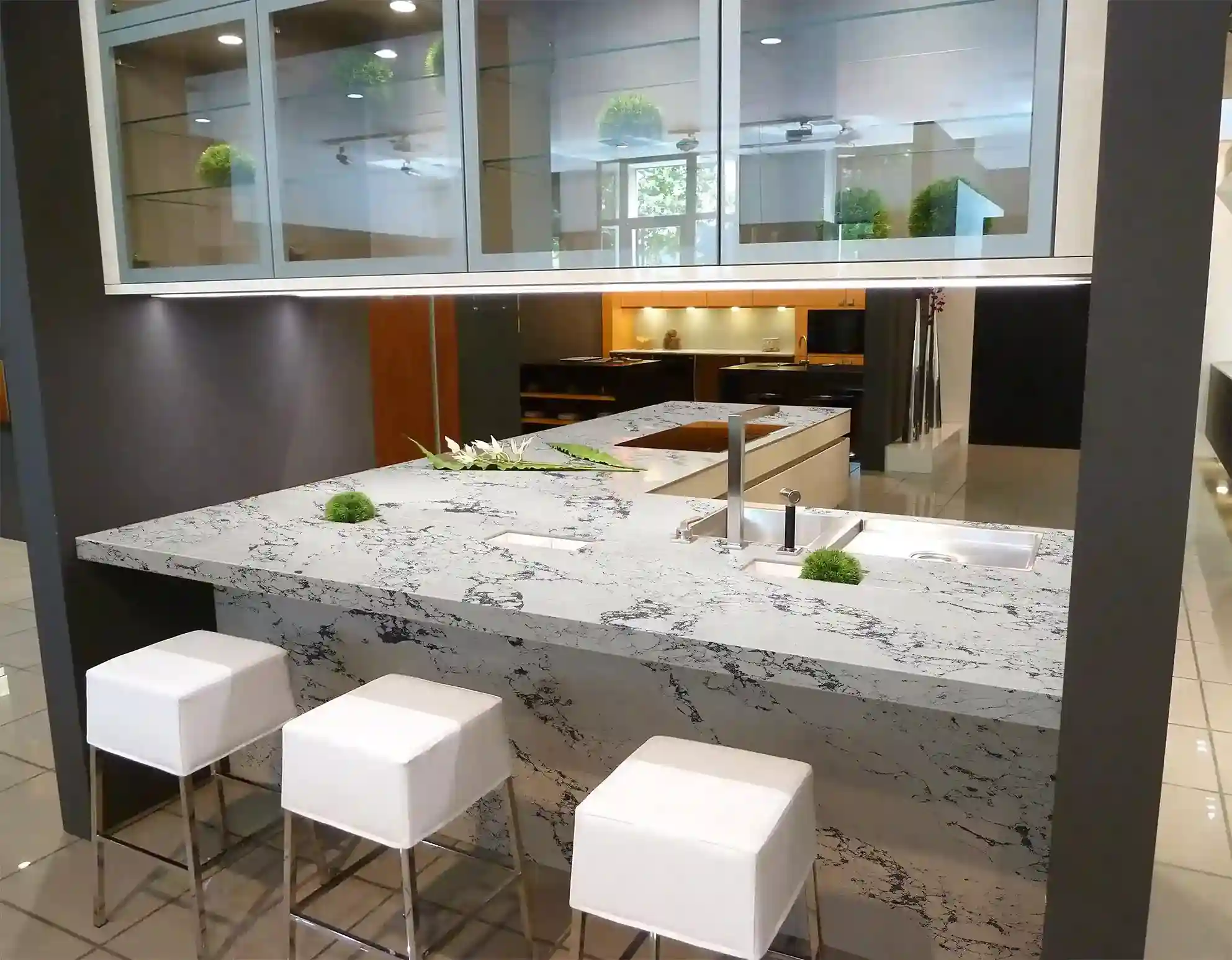
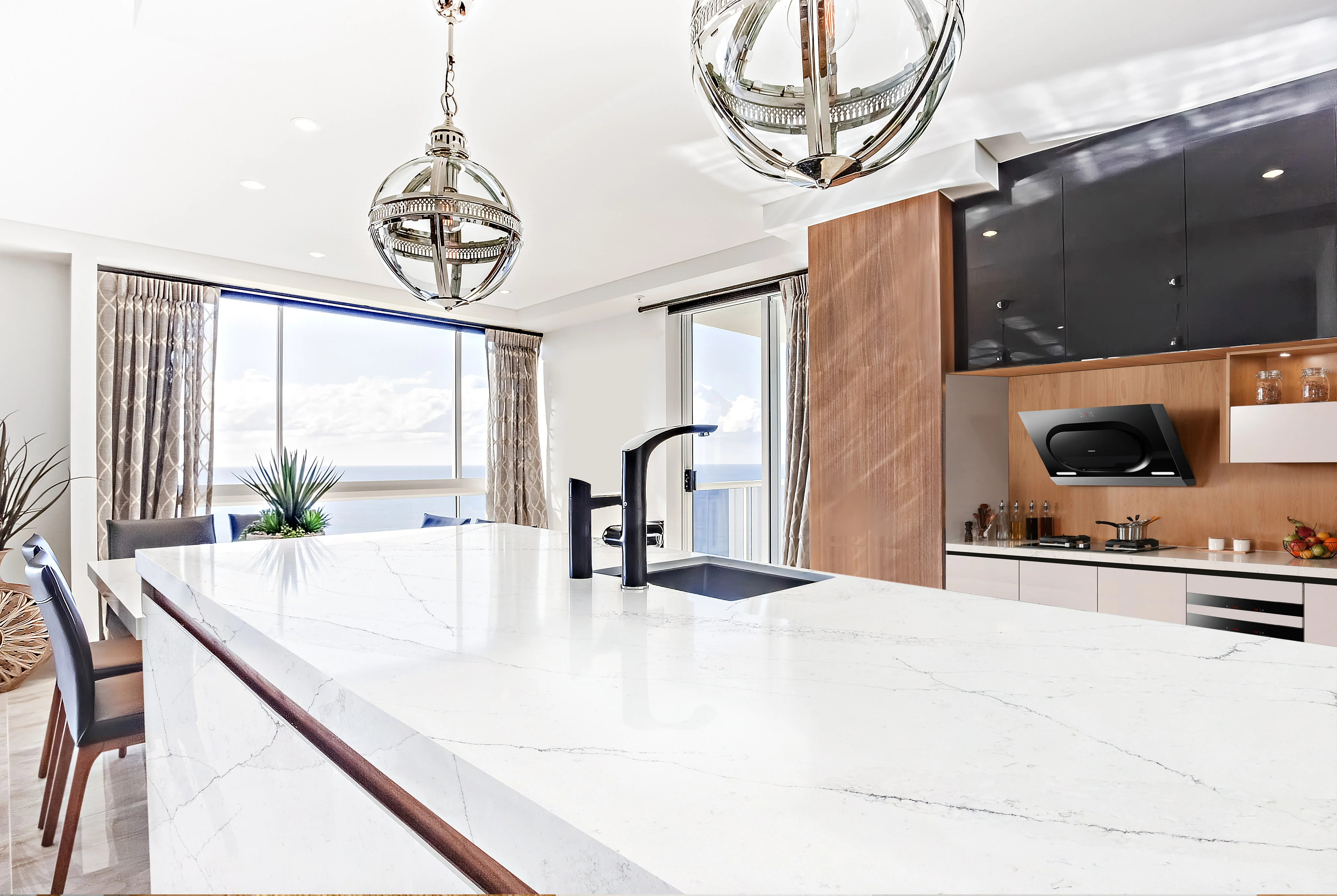
2. Heat Resistance & Thermal Shock: Can You Rest Hot Pans Directly?
Heat performance is one of the most frequently discussed differences between quartz and porcelain:
Quartz & Heat
While the quartz minerals themselves tolerate high heat, the polyester resins that bind them together do not. Sudden contact with high heat can cause thermal shock, resulting in resin discolouration, yellowing, scorched ring marks, or hairline cracks.
Rule: Never place hot pots, roasting trays, or heated air fryers directly onto quartz. Always use heat-resistant trivets or pads.
Porcelain & Heat
Because porcelain is kiln-fired at over 1,200°C and contains no organic binders, it is inherently non-combustible and significantly more heat-tolerant. Hot pans placed directly on the face of a porcelain slab will not scorch, melt, or burn the surface.
Nuance: Extreme temperature differentials can still create tension around glued mitred edges or slab joints. Stonemasons advise using trivets to avoid localised stress.
Note: Temperature thresholds vary across manufacturers and slab thicknesses. Always review the specific care and warranty terms for your chosen brand.
3. Scratch Resistance, Porosity & Everyday Stains
Kitchen worktops endure heavy daily use from cutlery, chopping, spilled sauces, and acidic liquids. Here is how both stones perform:
Scratch & Cutting Hardness
Both surfaces rate exceptionally high on the Mohs hardness scale. Quartz typically measures around 6.5 to 7, while porcelain achieves 7 to 8 (diamond being 10).
Porcelain is virtually impervious to surface scratches from stainless steel knives. However, cutting directly on porcelain will dull your kitchen knife blades rapidly. Quartz easily resists everyday prep work, but sliding rough unglazed ceramic mugs or cutting with heavy cleavers can create faint markings over time. In both cases, chopping boards remain best practice.
Stain Resistance & Non-Porous Hygiene
Unlike natural granite or Carrara marble, neither quartz nor porcelain requires chemical sealers. Both possess near-zero water absorption (<0.05%), meaning red wine, beetroot juice, espresso, balsamic vinegar, and cooking oils remain on the surface rather than penetrating into the stone. Routine wiping with warm water and mild dish soap is all that is required for spotless hygiene.
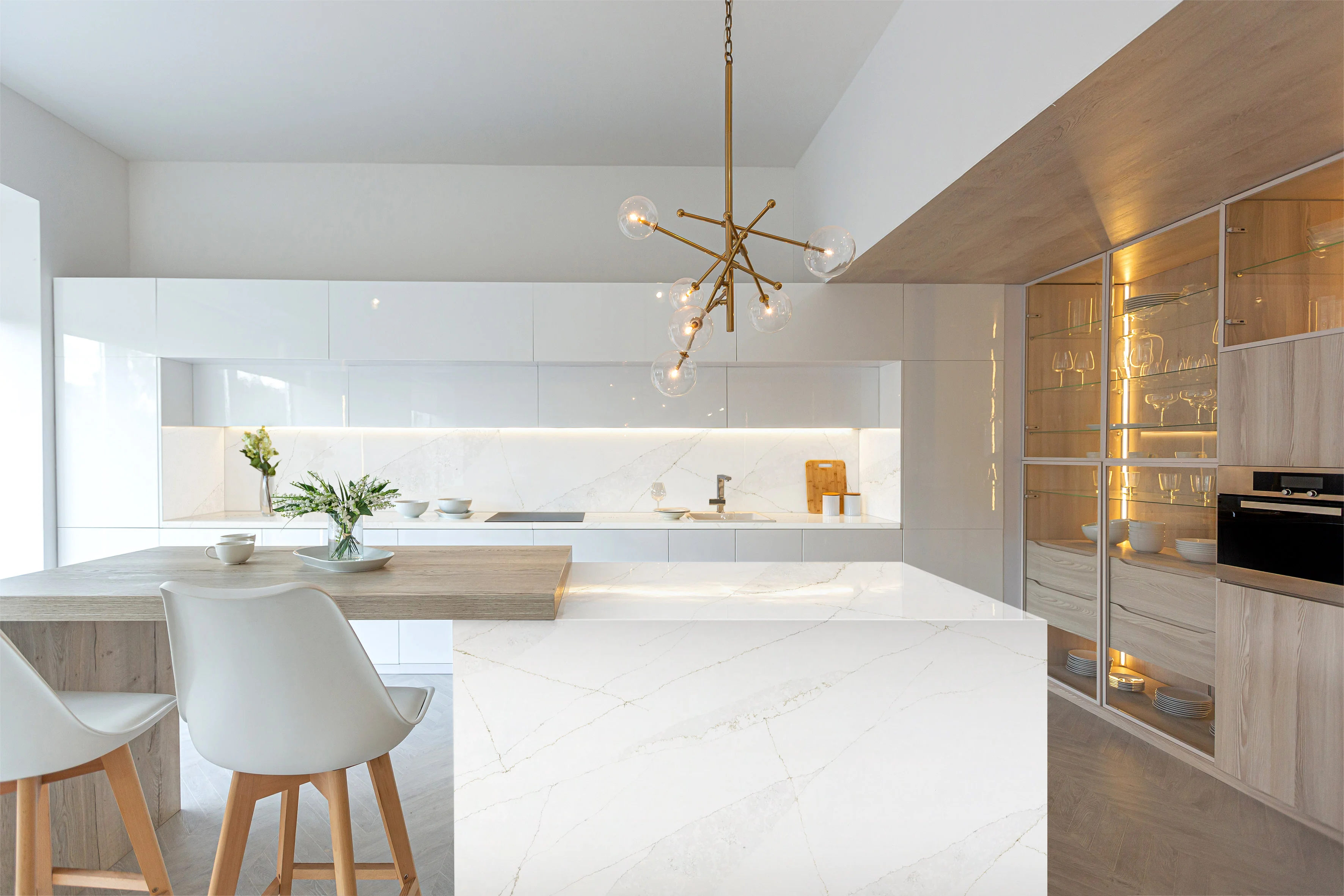
4. UV Resistance: Indoor Kitchens vs Outdoor Living
Where you plan to install your worktop determines which material is physically suitable:
Quartz: Indoor Use Only
The polymer resins used to bind quartz are sensitive to ultraviolet (UV) radiation. If installed in an outdoor kitchen, garden BBQ island, or an unshaded conservatory with relentless direct sunlight, the resins will gradually yellow, fade, or become brittle. Quartz is engineered specifically for interior environments.
Porcelain: 100% Weatherproof
Porcelain contains no organic resins or polymers. It is 100% UV-stable, weatherproof, and resistant to frost and temperature extremes. It will never fade or degrade in British sunlight or sub-zero winter temperatures, making it the premier choice for outdoor kitchen worktops and garden entertainment bars.
5. Impact Resilience, Chipping & Edge Profiles
While porcelain is harder than quartz, hardness can come at the expense of flexibility:
Impact Resistance & Chipping Risk
Because quartz contains resin polymers, the slab possesses a subtle elasticity that makes it more forgiving when struck by blunt impacts (such as an accidental knock from a heavy Le Creuset casserole dish on an edge). Porcelain, by contrast, is extremely rigid and glass-like. While the flat surface is virtually indestructible, sharp 90-degree edges and unmitred sink cutouts can chip if struck sharply by a heavy metal object.
Edge Profiles & Surface Patterns
Quartz is a solid-body or through-body material in many designs, allowing stonemasons to shape edges into diverse profiles (e.g. double bevel, full bullnose, ogee, shark nose, or pencil round) while maintaining pattern continuity. Learn more on our bespoke edge profiles page.
Most porcelain slabs have high-definition designs printed digitally on the top surface. Unless a specialised "through-body" slab is selected, the internal ceramic core is often a uniform white, grey, or terracotta tone. To achieve a thick visual edge, stonemasons craft precision 45-degree mitred apron joints rather than rounded bullnose curves.
Repairability
If an edge chip occurs on quartz, an experienced stone technician can often fill and polish the area using colour-matched acrylic or epoxy resin, making the repair virtually invisible. Repairing chipped porcelain is significantly more difficult, as resin fills rarely match the high-definition ceramic surface texture perfectly.
6. Available Thicknesses, Weight & Kitchen Islands
Slab dimensions and structural weights influence cabinet planning and island overhang designs:
Quartz Thicknesses
- 20mm: Modern, crisp profile ideal for contemporary cabinets.
- 30mm: The classic British standard. Heavy, solid, and capable of spanning island overhangs up to 300mm without steel support brackets.
- Substrate: Self-supporting; sits directly on standard kitchen base units.
Porcelain Thicknesses
- 12mm: Ultra-slim architectural profile favoured in minimalist German and Scandinavian kitchens.
- 20mm: Robust worktop thickness offering greater structural integrity.
- Substrate: 12mm slabs often require a flat moisture-resistant sub-top (plywood base) or steel cantilever supports on breakfast bars.
7. Fabrication Complexity & Overall Cost Factors
When planning your kitchen renovation budget, it is important to distinguish raw slab cost from the total fitted price:
Fabrication & Tooling Differences
Because porcelain is extremely dense and fired under immense pressure, cutting and fabricating it requires specialist waterjet technology, diamond blades running at calibrated speeds, and stress-relieving cuts around sink and hob apertures. This increases the labour time and tooling wear compared to standard quartz processing.
What Influences the Final Quotation?
Total fitted costs for both materials depend on:
- Material Brand & Tier: From competitive house collections like MQS Quartz to luxury brands like Cosentino Silestone or Dekton.
- Total Slab Area: Number of jumbo slabs required to eliminate visible seams.
- Cutout Complexity: Undermount sink cutouts, tap holes, flush-mount hob recesses, and drainer grooves.
- Edge Detailing: Standard pencil edges versus built-up 40mm or 50mm mitred aprons.
In general, quartz offers greater budget flexibility across entry and mid-tier price bands, whereas fitted porcelain projects tend to fall into the upper-mid to premium investment bracket due to specialised installation labour.
Calculate Your Exact Worktop Cost
Get an itemised quotation tailored to your kitchen layout, sink preferences, and chosen material range.
Get a Free Online Quote8. Which Surface Best Matches Your Lifestyle?
Use this straightforward checklist to confirm which stone surface best suits your kitchen and culinary habits.
Choose Quartz If:
- You have a lively family home with young children where heavy pots and pans are frequently handled.
- You prefer the substantial, traditional presence of a 30mm solid stone worktop.
- You want a wide range of edge profiles, including classic bullnose, ogee, or bevel shapes.
- You are seeking maximum value with flexible price tiers across different colour collections.
- Your kitchen is entirely indoors and protected from intense outdoor sun exposure.
Choose Porcelain If:
- You are planning an outdoor kitchen, garden BBQ island, or sun-drenched extension.
- You want an ultra-modern, slim 12mm or 20mm profile for a handleless or industrial design.
- High-temperature resistance is a top priority for hot pans and intensive cooking.
- You want unmatched scratch resistance and are happy to use chopping boards to protect your knives.
- You love high-definition industrial finishes like oxidised metal, slate, or raw concrete.
Browse Popular Quartz & Porcelain Collections
We supply and fabricate leading stone brands across London, Brent, Harrow, and Wembley.
MQS Quartz Collection
Direct factory quartz providing exceptional quality, timeless marble veining, and accessible pricing.
View MQS Collection →Silestone by Cosentino
World-renowned hybrid quartz surfaces featuring HybriQ+ technology and premium suede finishes.
View Silestone →Caesarstone Quartz
Pioneering quartz designs offering realistic natural stone textures, concrete styles, and honed surfaces.
View Caesarstone →Caesarstone Porcelain
Sintered porcelain surfaces pairing ultra-compact performance with dramatic architectural veining.
View Porcelain →Still Deciding? Let Our London Stonemasons Help
Whether you choose durable engineered quartz or sleek sintered porcelain, our Wembley team provides free material samples, precision laser templating, and factory direct pricing across London.